

Aleksandr Baniusevič – Person of the Year 2025
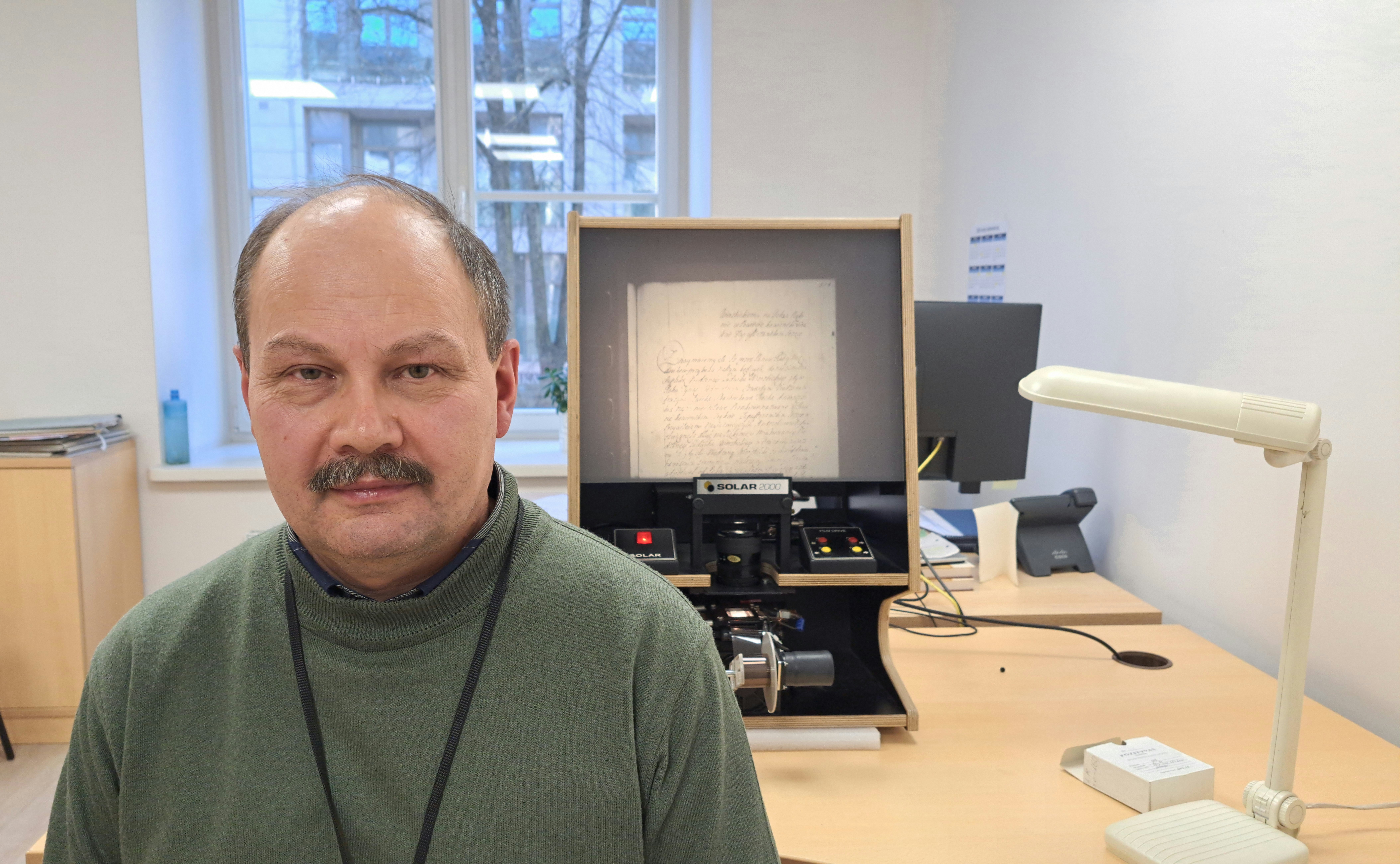
Aleksandr is a long-standing member of our archive: he has spent 33 years working here as an archivist. The Lithuanian State Historical Archives is his first and only workplace. After completing studies in history and law at the former Vilnius Pedagogical Institute and joining our institution, Aleksandr began working with archival documents of exceptional value – the Old Acts of the 16th–18th centuries. For many years, he has been compiling inventories and indexes of the Old Acts fonds and preparing their descriptions.
Reading texts written in Ruthenian, Latin, and Polish, and especially understanding them, requires highly specialized knowledge. Aleksandr is one of the rare archival specialists capable of meeting the challenge of reading 16th–18th-century manuscripts.
At the initiative of A. Baniusevič, the Old Acts catalogues compiled during the Russian Empire period by Nikita Gorbachevsky and Ivan Sprogis were fundamentally reorganized. The archivist prepared new Old Acts inventories written in Lithuanian, accompanied by explanatory notes in Lithuanian. This year, Aleksandr also joined the Transkribus project launched in our archive, in which handwritten texts are converted into printed text with the help of artificial intelligence. Within this project, A. Baniusevič is responsible for the transcription of the Old Acts.
This year, Aleksandr undertook another major task – he began compiling a new inventory of the Lithuanian Metrica, which will replace the one prepared back in 1887 by Stanislovas Ptašickis. This came as a surprise even to Aleksandr himself: at first, it seemed that translating the Russian titles of the Lithuanian Metrica book inventory would suffice. However, as the work progressed, it became clear that the old inventory needed to be thoroughly revised and expanded.
Aleksandr is pleased that in recent years more attention has been paid in our archive to scholarly research and, consequently, to the study of the oldest documents. “Who reads them?” he used to hear before. “Yet this is an extraordinarily important heritage of the Grand Duchy of Lithuania, the history of our ancestors,” Aleksandr notes.
His daily work with the Old Acts requires not only specific knowledge and skills, but also great patience—nothing in this field happens quickly.
“My work may seem boring to others, but certainly not to me. It depends on one’s character. Already during my studies, I sensed that the fate of a teacher was not meant for me. I prefer working with documents rather than with people. People can be very different, but with documents, one can always find common ground.”
“If I didn’t like this job, I wouldn’t do it. That is the main motivation that this work is close to my heart and that I feel I am in the right place. It is important to me to do something useful not only for the archive, but for society as a whole,” says A. Baniusevič.
In his free time, he enjoys reading books, spending time in nature, hiking in the mountains, and taking active educational trips around Lithuania and abroad.
We congratulate our colleague on this honorable recognition!
Last updated: 30-12-2025
Related news:
International Exhibition “Martynas Liudvikas Rėza”
Minister of Foreign Affairs Kęstutis Budrys Visits the Lithuanian State Historical Archives